Princess cut is one of the most sought-after diamond cuts, second only to the classic round cut in popularity. Princess cut diamonds have a square shape when looked at from above and are a good choice for engagement or wedding rings. Let’s take a look at the most important facts you should know when shopping for princess cut diamonds.
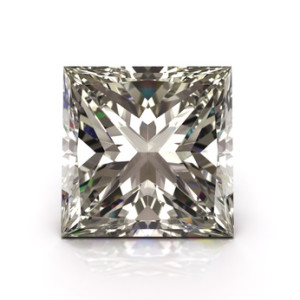
Princess cut diamond
Price of Princess Cut Diamonds
Princess cut diamonds are generally cheaper per carat compared with their round cut counterparts.
The main reason for this is that when raw diamond is shaped into a princess cut, less material is wasted than when cutting a round stone.
Here you can check out current prices for princess-cut diamonds.
Evaluating Princess Cut Quality Characteristics
When it comes to assessing cut quality, there is no uniform agreement as to what proportions the best princess cut should have.
Even if the diamond you buy is certified by the G.I.A. (Gemological Institute of America), its cut won’t be assigned an overall quality grade in the grading report (unlike the round cut). You will only be able to see a grade for the diamond’s polish and symmetry, which should have a grade of at least Good.
Generally, the best cut will maximize the stone’s brilliance, without making the diamond look too deep or too shallow.
The rule of thumb for princess cut diamonds is to look for stones whose total depth (or height) is about 70% of their width (5 percentage points should be an acceptable deviation from this number, up or down).
When looked at from the top, the diamond should look square (stones that look rectangular are usually cheaper).
The most important specifications on which a princess cut is evaluated are its girdle, length-to-width ratio, depth and table percentages, and the presence of a culet as well as its size.
Let’s take a more detailed look at these quality characteristics:
Girdle
The girdle of a diamond is its widest part.
This outer edge can have a thickness grade that ranges from Extremely Thin to Extremely Thick.
For princess-cut diamonds, the optimum girdle thickness ranges from Very Thin to Thick.
Diamonds with Very Thick girdles are undesirable because their other proportions are distorted due to the overly large girdle.
Extremely Thin girdles are also to be avoided because they are vulnerable to chipping.
The thickness of a princess-cut diamond’s girdle is measured vertically, so you will simply need to determine its height.
Length-to-Width Ratio
The length-to-width ratio of a princess-cut diamond tells you how close its shape is to square. The length and width of a princess cut are measured along the girdle.
Usually, the length-to-width ratio in princess cuts is around 1-1.1. Values closer to 1 are more desirable for this type of cut, whereas ratios above 1.1 are less sought after.
Depth Percentage
The depth of a princess-cut diamond is the distance from its table to the bottom of the stone.
The depth percentage of a princess-cut diamond is calculated by dividing the depth of the stone by its width.
It is best if this value is between 65% and 75%. Values in the 58%-64% and 75%-80% ranges are also considered good.
Princess cuts with depth percentage values below 58% and above 80% are considered fair or poor quality.
Table Percentage
The table of a princess cut is the rectangular flat facet on the top of the stone. (The width of the table is less than the width of the entire diamond.)
The table percentage is calculated by dividing the width of the the table by the width of the stone as measured along the girdle.
A table percentage of 60%-75% is considered best for a princess cut. Diamonds with tables in the 75-80% or 56%-60% range are also considered well cut.
In general, avoid princess cuts whose table percentage is higher than 85% or lower than 55%.
Culet
The culet is the small flat facet on the bottom of a diamond. Often, the culet is missing, and the bottom is simply a pointed end.
It is best if the culet is small or if there is no culet at all. (Some people prefer to have a culet because they think sharp diamond bottoms are more likely to chip.)
Medium to large culets are undesirable because they are too visible when the stone is looked at from the top and spoil the appearance of the table’s light pattern.
Selecting Clarity
One of the good things about princess cut is that its proportions allow it to exhibit a decent amount of brilliance and sparkle, which make the stone’s inclusions less visible.
(Round diamonds rank highest in this respect, whereas most other shapes are less sparkling.)
It is worth noting that princess cut diamonds with clarity lower than SI1 are rare.
That’s why the best way to find a stone with decent clarity at the lowest price is to focus on stones graded VS1, VS2 and SI1. When looking at diamonds in this clarity range, look for stones that don’t have inclusions visible with the naked eye.
Click here to take a look at real VS1/VS2/SI1-clarity princess-cut diamonds.
There is one other thing you should pay attention to: Make sure that the stone you choose doesn’t have serious inclusions in its corners, which are the weak spots of this cut. If there are large inclusions in these places, the corners will be weakened even further and be more prone to chipping.
Choosing Color
When evaluating the color of a princess cut diamond, look for stones that don’t have a visible yellow tint. This means that you shouldn’t go lower than the Near Colorless range (which contains the G, H, I and J grades).
Click here to see a selection of G/H/I/J-color princess-cut diamonds.
Although with round cut stones you have more leeway in terms of color (i.e., stones graded J or even K can still look reasonably colorless because the cut masks tints well), with princess cut diamonds you shouldn’t go lower than the I-color grade or you will start seeing some yellow.
Should you go even higher and buy a Colorless princess cut stone (i.e., one graded D, E or F)? It is up to you, but it is usually not worth the additional money you’ll pay as you won’t be able to see a noticeable difference in color with the naked eye.
Selecting a Setting for a Princess Cut Diamond
When buying a princess cut diamond, you should make sure that it is set in a mounting that protects the stone’s corners. Since this is where the diamond gets very thin, if the corners are not well protected, a strong blow can chip them.
A V-prong setting, for example, is a great choice for keeping a princess cut stone safe.
A note on diamond accents: If your princess cut diamond is going to be set together with other stones, make sure that the accent diamonds are the same color as the center stone or no more than one grade apart.
Princess-Cut vs. Other Square-Cut Diamonds: What Are the Differences?
Rectangular diamond cuts whose all four sides are equal when looked at from the top are referred to as square cuts. If a jeweler tells you that a rectangular diamond has a length-to-width ratio of 1, this means the same thing – i.e. the cut in question has a square shape.
Most rectangular cuts have square variations, and the most popular square cuts are the princess cut, the emerald cut, the Asscher cut, and the radiant cut. The cushion cut can also be considered a square cut by some, although its profile has rounded corners.
Princess Cut vs. Radiant Cut
Unlike the princess cut, the radiant cut doesn’t have sharp corners – they are truncated.
See here a collection of radiant-cut diamonds.
The radiant cut tends to have slightly more depth. It also reflects light differently, and its brilliance looks more sparkly, whereas the princess cut exhibits a more linear pattern of light reflection.
Radiant cuts tend to retain more color compared with princess cuts.
It is recommended that a radiant should have a color grade of no less than F, G or H if set in white gold or platinum, and I or J if set in yellow gold.
(For the sake of comparison, the recommended minimum grades for princess cuts are in the G-H-I range for white metals and in the J-K range for yellow gold).
Princess Cut vs. Emerald Cut
The emerald cut is a step cut, meaning that it is not designed to maximize brilliance, unlike the princess cut, which is a brilliant cut. (Browse emerald-cut diamonds here.)
The facets of the emerald cut are shaped and arranged in a more linear fashion compared with those of the princess cut. The emerald cut also displays much less brilliance and sparkle.
Because of this characteristic, depth is not as important for this type of cut as it is for the princess cut, in which a shallow bottom can result in reduced brilliance.
The emerald cut also tends to show color more easily than the princess cut, and it is not recommended to go lower than H color when buying an emerald-cut stone, especially if you are going to set it in white gold or platinum.
Any color grade lower than that may have visible yellow tints.
Because of its low brilliance, the emerald cut does not mask flaws well. This is why you should not buy a clarity grade lower than VS1-VS2 or you may start seeing inclusions visible with the naked eye.
Princess Cut vs. Asscher Cut
The Asscher cut is the square variation of the traditional emerald diamond cut. Similar to the princess cut, the Asscher cut has a rectangular-looking shape with truncated corners. Here you can see a selection of Asscher-cut diamonds.
Both the emerald cut and the common Asscher cut have 58 facets, but there is a variation called “Royal Asscher Cut” that has 74 facets.
Despite their similar profiles, the princess and the Asscher cut differ in the way they are shaped, which also affects how brilliant and colorless they look.
Let’s examine these differences in more depth:
Cut
While both cuts appear similar, they are actually fundamentally different in terms of how their facets are shaped and arranged.
The Asscher cut is a step cut, meaning that its facets run parallel to the girdle and/or each other.
The princess cut, on the other hand, is often referred to as a “modified brilliant cut,” and its facets are not shaped and arranged in the linear manner Asscher diamonds are cut.
Brilliance and Sparkle
As already mentioned, the princess cut belongs to the group of so-called “brilliant cuts,” which are shaped so as to maximize brilliance. Step cuts such as the Asscher or emerald cut are not cut with the same primary goal in mind. As a result, princess-cut diamonds have more brilliance and sparkle compared with Asscher-cut stones.
Check out these diamond ring settings and see how you can design your own diamond ring.
Important: When selecting a princess-cut diamond, pay attention to the depth of the stone as this characteristic affects how well the diamond will reflect light to exhibit good brilliance and sparkle. In general, a well-cut princess diamond will have depth that is around 70% of its girdle (give or take 5 percentage points). Since Asscher stones are not cut to maximize brilliance, depth is not as important for them, and you can choose a shallower stone that will look larger because its top facet will be bigger. For Asscher cuts, the recommended depth range is 60%-70%.
Color
Since princess cuts have more brilliance, which can make yellow tints less visible, these diamonds show less color than Asscher-cut stones. So, when choosing a princess-cut diamond, you can go as low as H or I color and not see any visible yellowish hues. With Asscher cuts, however, you need to be more careful as any color present in such stones tends to be more visible – don’t go lower than H color with diamonds of this cut.
Clarity
The characteristic way the facets of an Asscher-cut diamond are arranged not only makes its color easily visible but also causes its flaws and impurities to stand out more. This is why it is not recommended to buy an Asscher stone whose clarity is graded lower than VS1-VS2, as diamonds of this cut in the SI1-SI2 clarity range will likely have inclusions visible with the naked eye.
With princess-cut diamonds, you have more leeway, as their brilliance tends to mask their imperfections better. In general, with these stones, you can go as low as SI1 clarity and still not see obvious flaws if you take your time to look for an eye-clean diamond.
Princess Cut vs. Cushion Cut
The cushion cut does not look exactly rectangular because of its rounded corners, which make it look more like a pillow. There are many variations of the cushion cut, which, like the princess cut, belongs to the group of brilliant cuts.
Click here to browse a collection of cushion-cut diamonds.
Because of the variety of cushion cuts, it is hard to say how this cut differs from the princess cut in terms of brilliance – some cushion cuts are as brilliant as a proportional princess-cut; others may display significantly less brilliance because of the shape of their facets.
What to Pay Attention to When Choosing a Square Cut
When choosing a square cut, it is important to see how each of the diamonds you are considering will look when worn compared to the others.
Be sure to evaluate the brilliance, color, and clarity of each stone with your own eyes, and do not rely only on the written grading reports for the diamonds.
Don’t forget that unlike most other square cuts, the princess cut has sharp corners, which need to be protected by the setting. One of the best options is to set such a stone in V-shaped prongs, which will hold its ends securely with metal.
Where to Buy Diamond Jewelry?
We recommend James Allen (read review) because you can see a 360-degree video for any diamond before buying it.
Blue Nile is another reputable diamond retailer we recommend.