The Characteristics of the Radiant Cut
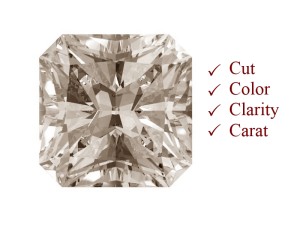
The radiant diamond cut has a rectangular or square shape, and its corners are truncated.
Its outline looks very similar to that of the emerald cut, but unlike it, the radiant cut is actually a brilliant cut.
This means that the facets of radiant diamonds are arranged so as to maximize brilliance.
(The radiant cut is also referred to as a “mixed cut,” as it also has characteristics of step cuts, such as the emerald cut.)
Evaluating the Cut Quality of Radiant Diamonds
The quality guidelines for the radiant cut are not as detailed and precise as those for the round cut, but here are some recommended ranges for the most important proportions:
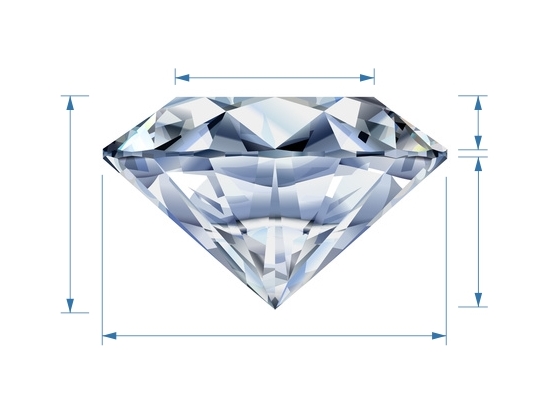
Table ratio (the length of the top as a percentage of the girdle) should ideally be around 60-70%.
Total depth (the distance from the top of the stone to its bottom) should be 60-65% of the girdle.
Girdle thickness should be very thin to slightly thick; extremely thick or extremely thin girdles are undesirable.
The culet (the facet at the stone’s bottom) should be small or nonexistent. Medium to big culets may be visible through the top of the stone.
The symmetry and polish of the stone are secondary in terms of importance, but you should avoid radiant diamonds that are graded Poor on these characteristics.
Asymmetrical facets and a poorly polished surface can impair the look and even the brilliance of a stone.
Choosing a Color Grade for a Radiant Diamond
The color of radiant cuts is graded on the same scale as that of all other diamonds, but you should be aware that radiants tend to show more color than round cuts.
If your radiant diamond is going to be set in a white setting, such as one made of platinum or white gold, then it is recommended that the stone’s color be in the F-G-H grading range.
For yellow gold settings, you can go lower, as any yellowish tints in the diamond will be absorbed by the setting’s color – you can get an I or J color, and it will still look reasonably colorless when set.
Selecting Clarity for Radiant-Cut Diamonds
Selecting a clarity grade for a radiant-cut diamond boils down to finding a stone that doesn’t have visible flaws.
The good thing about radiant cuts is that because of their brilliance, inclusions tend to not be as visible as in less brilliant cuts (e.g., step cuts).
While it is easy to go for the highest clarity grades (i.e., FL or IF clarity), this is quite an expensive choice. There are lower-clarity radiant diamonds that do not have visible inclusions but are cheaper.
If you go as low as VS2 or SI1 clarity, or even SI2 clarity, you may find an eye-clean stone (i.e., one whose flaws cannot be seen from a normal viewing distance) at a pretty good price.
Radiant Cuts and Carats
When choosing the carat of your radiant-cut stone, you should keep in mind that the bigger a diamond, the more visible its imperfections such as inclusions or yellow tints.
Therefore, if you are ready to spend additional money for a radiant diamond of higher carat weight, don’t forget that you may also need to pay more money for better color and clarity.
What Is the Difference Between Radiant and Cushion Cut Diamonds?
The cushion cut has a rectangular or square outline. The sides and corners of these diamonds are slightly rounded, creating a pillow-like appearance, which is the reason for this cut’s name.
Click here to see a selection of cushion-cut diamonds.

The radiant cut and the cushion cut are so similar that it is hard to pinpoint the aspects in which they differ.
Here are the most important factors you should consider when comparing these cuts:
Shape
One of the most visible differences between radiant and cushion cut is in the way they are shaped. The radiant cut has a rectangular outline and its corners are cut.
The cushion cut, on the other hand, has sides that are more rounded, so its profile does not look as rectangular. Some cushion cuts can be so rounded that they may actually look oval.
Cut and Facets
Both the radiant and the cushion cut belong to the group of the so-called “brilliant cuts.” This means that their facets are shaped and arranged in a way that enhances brilliance. Although these two cuts differ somewhat in the number and shape of their facets, these differences are visible from a close distance. Besides, the cushion cut has so many variations that it is hard to list all dissimilarities between them and the radiant cut. From a normal viewing distance, a radiant and a cushion cut look similar, and the most salient difference is in their face-up outline.
More: See how you can design you own diamond ring online.
Brilliance
Cushion cuts that have bigger facets may exhibit noticeably less brilliance than radiant cuts – this is often the case with the so-called “antique” variations of the cushion cut. Most modern variations of this cut, however, are pretty close to the radiant cut in terms of brilliance. Anyway, in order to compare two diamonds of each cut, you would need to evaluate them side by side and see which stone has more sparkle.
Clarity and Color
In general, there is no significant difference between a cushion and a radiant cut in terms of how visible their color or inclusions are (if both stones have the same clarity and color grades). Just remember that if a diamond has a cushion cut variation that has lower brilliance, the stone’s flaws or yellow tints (if any) might not be masked as well as they would in a similar-quality radiant stone.
Conclusion and Shopping Advice
As you can see, the differences between the radiant and the cushion cut are not dramatic. Even their shapes look similar. And because of the vast diversity of cushion cut modifications available, you should compare radiant and cushion diamonds on a case-by-case basis. In the end, our recommendation is that you choose between the two based on your personal preferences for shape and sparkle.
Radiant Cut vs. Princess Cut Diamonds
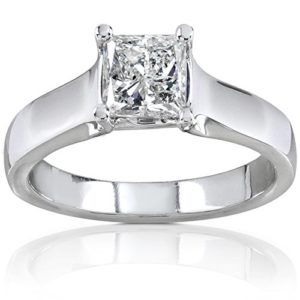
A ring with a princess-cut diamond
The princess cut has a rectangular outline and is very popular among people looking for a square or rectangular diamond. This is a brilliant cut that was created in the 1960s, and it has become second to only the round cut in terms of popularity.
One of the most obvious differences between the princess and radiant cut is in their shape. Although both are rectangular, the corners of the princess cut are not truncated, unlike those of the radiant cut. The princess cut tends to be deeper, while the bottom of the radiant cut tends to be shallower. These two cuts differ also in the number and shape of their facets, as well as the way they are arranged.
Princess vs. Radiant Cut: How They Differ in Brilliance and Sparkle
The radiant and the princess cut differ in terms of their brilliance and sparkle, and these differences result from the different ways in which the two types of cut are shaped. It is hard to say which cut has more brilliance, as both are created to maximize this characteristic, so you should make this comparison on a case-by-case basis. It is more appropriate to say that the brilliance and sparkle of these two cuts are just different.
Princess cuts reflect light in a more neat and orderly fashion because of the regular and linear way their facets are arranged. Radiant cuts, in contrast, have a more fiery brilliance and can seem more sparkly.
So, when comparing a princess-cut stone with a radiant-cut diamond, the former will reflect light in a more regular pattern, while the latter will exhibit a more haphazard reflection.
How Princess Cut and Radiant Cut Differ in Diamond Color
Princess cuts have excellent brilliance, which helps to conceal to a certain extent any yellowish tints the stone might have. If you are buying a princess-cut diamond with the intention of setting it in white gold or platinum, it is recommended that you stick to color grades in the G-H-I range.
For yellow gold settings, you can go as low as J or K color before the yellow tints in the stone start to spoil its appearance. Because of the way the facets of radiant cuts reflect light, yellow tints in them tend to be more visible than in princess cuts.
Depending on how well the stone is cut and masks color, it is recommended that you select a radiant cut whose color grade is in the F-G-H range, for white gold or platinum settings. For yellow gold settings, it is usually safe to go a little lower and select I or J color.
In general, pay more attention to color when you are selecting radiants.
Choosing a Setting for Radiant and Princess Cut Diamonds
When deciding between a radiant cut and a princess cut, don’t forget to think about the setting for the diamond. Because of its sharp corners, a princess-cut stone should be put in a mounting that protects its vulnerable ends. A setting with V-shaped prongs to hold the diamond’s corners securely is a good choice for this cut.
Another good option is a bezel setting. Radiant cuts can be set with regular prongs or bezels, which are the two most popular types of settings.
Where to Buy Diamond Jewelry?
We recommend James Allen (read review) because you can see a 360-degree video for any diamond before buying it.
Blue Nile and Ritani (use code SAVE5 to get 5% off natural diamonds) are other reputable diamond retailers we recommend.