What Types of Gold Are Used to Make Jewelry?
Let’s see what types of gold exist and how they are created.
Yellow Gold
Yellow gold is the most common type of gold used in jewelry. It should be noted, however, that although yellow is the natural color of gold, yellow gold is not the same as pure gold. Since this metal is very soft, it is not suitable for jewelry making unless it is mixed with other metals to make it harder.
The yellow gold jewelry you see in stores has varying degrees of purity depending on how much actual gold it contains as measured by its karat. The lower the percentage of gold content in a piece, the lower its karat number is.
In general, lower-karat gold jewelry has a yellow color that is less intense than that of higher-karat pieces. Low-karat items are also harder and more durable than gold jewelry that is purer.
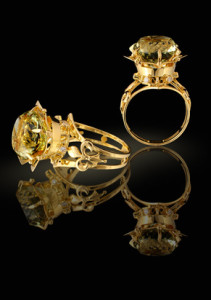
Gold rings with gemstones
Colored Gold
Since yellow is gold’s original color, any alloy of this metal that has a different hue is considered colored gold. The color of a gold alloy depends on what other metals are included in the mix. Here are the most common varieties of colored gold:
White Gold: This is the most popular gold alloy used in jewelry. To achieve a white color, gold is mixed with metals such as palladium or nickel. Adding white metals is not enough to get a perfect white color, though, and a white gold alloy still looks a bit yellowish. This is why it is plated with rhodium, which actually gives white gold jewelry its color and luster.
Rose Gold: Rose gold owes its color to the copper that is mixed in the alloy. The more copper there is, the more pronounced the rose color becomes. High-copper rose gold alloys have an intense reddish hue and are therefore also known as “red gold.” Rose gold varieties that contain less copper have a faint color; for that reason, those alloys are also called “pink gold.”
Black Gold: A gold alloy can be turned black by using several methods. One way is to simply cover the surface of the piece with a black compound (such as black rhodium). Another option is to treat the surface of the item with certain chemicals so that it changes color. It is also possible to change the color of a gold alloy containing cobalt, copper, titanium, or iron by causing its surface to oxidize through the use of heat.
Green Gold: This type of alloy is made by mixing gold with silver (and more rarely, cadmium). The green color is usually not very intense, and most green gold looks more like yellow gold with a greenish hue.
Grey Gold: The grey color of this alloy is achieved by mixing gold with copper, silver, and manganese.
Purple Gold: The purple color of this alloy is achieved by adding aluminum and pure gold together. Purple gold is, however, not very durable and can break easily because the compound is relatively brittle.
Blue Gold: One way to produce blue gold is to mix indium with pure gold. Like purple gold, the resulting blue gold compound tends to be brittle. An alternative way to make blue gold is to mix gold with iron or rhodium and treat the resulting alloy with heat so that the mixture oxidizes and forms a blue layer.
What Is Black Hills Gold?
Black Hills Gold is a type of gold jewelry that has a distinctive design and is manufactured in the Black Hills area in South Dakota, United States. A piece of Black Hills gold jewelry is typically handcrafted and is usually made with gold colored in more than one tone.

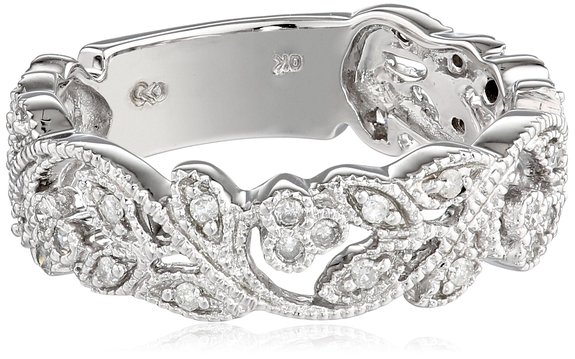
Black Hills Gold ladies’ 10K band ring
The Black Hills Area
Black Hills is a mountainous region in western South Dakota. The hills there were considered sacred by the Native American tribes that inhabited the area. In the 1870s, during the gold rush, there was an influx of prospectors looking for gold. Many of them set up their camps in and around the biggest local towns: Deadwood, Central City, and Lead. Around that time, Hill City and Custer City were established in the southern part of the Black Hills.
History of Black Hills Gold
It is said that Black Hills Gold was first made in the 1870s by Henry LeBeau, a French goldsmith, who claimed that the idea for the jewelry design had occurred to him in a dream after he had passed out from starvation and thirst.
Other sources claim that Black Hills gold jewelry was created by S.T. Butler, a local goldsmith who lived in the area in the 1860s. In 1919, Butler’s grandson, F.L. Thorpe, started a company manufacturing Black Hills gold jewelry in the city of Deadwood.
Today, there are many jewelers in the area making Black Hills gold jewelry. In fact, for a piece of jewelry to be sold as Black Hills Gold, it must be made in the Black Hills area.
Black Hills Gold Jewelry Design
It should be noted that the term Black Hills Gold does not denote a particular type of gold (unlike the terms “white gold” and “yellow gold”). The name is actually used to refer to the unique design of the jewelry. The characteristic design of Black Hills gold jewelry features elements such as grapes, leaves, and vines.
The pieces themselves are usually made with gold colored in three main hues: pink, green, and yellow. The pink gold used in Black Hills jewelry is made by mixing pure yellow gold with copper, whose concentration in the alloy determines how intense the pink color will be. The green gold used to create the grape leaves and stems is made by adding silver and pure gold together.
Usually, the different elements of Black Hills gold jewelry, i.e., the leaves, grapes, and stems, are first manufactured separately and then soldered together onto a common base.
How Do I Choose the Best Gold Ring?
Let’s take a look at the most important factors you should consider before buying a gold ring.
What Karat Should My Gold Ring Be?
Gold karat is a number that tells you how many parts pure gold are in a jewelry piece, out of a total of 24 parts. For example, 10-karat gold rings contain approximately 42% gold (10 divided by 24), and the rest is other metals such as zinc, nickel, etc.
As you might guess, higher karat gold is more expensive as it is purer, so take price into consideration when deciding on a karat.
However, there is another factor that is sometimes overlooked: durability. Since pure gold is very soft, the lower the karat of your gold ring, the harder and more durable it will be.
Here are some simple rules to help you decide when you should go for a higher or lower karat:
Low-karat gold rings (e.g., 10k or 14k) are suitable for everyday wear as they are harder to scratch and will need to be polished less often.
In addition, ring parts made of low-karat gold are not bent or broken as easily as those made of purer gold.
High-karat gold rings (e.g., 18k, 20k or 22k) are a good choice for pieces that you will not wear often. They will look yellower than low-karat rings but will also scratch more easily.
Rings made of purer gold will also wear down more quickly, and their parts will be easier to break.
Does the Gold Ring Contain Nickel?
Nickel is a metal that is commonly added to gold alloys. The problem with it is that it can cause skin rashes in people allergic to nickel.
If you have such an allergy, do not buy 10k gold rings as the concentration of nickel in them could be too high for you. 14k gold rings may be a better choice, but sometimes they can also be problematic for people with an allergy.
To be on the safe side, pick a ring that is 18k and above. It’s not that purer gold rings cannot contain nickel, but its concentration in higher karat gold is usually too low to cause allergy symptoms.
What Should the Ring Setting Be Made Of?
If your gold ring has a gemstone set in it, make sure you know what the setting is made of. This is especially important for prong settings, where the stones are held in place by tiny posts.
If these prongs are made of yellow gold, they will wear out quickly because of the softness of the metal, and if one or more worn prongs bend or break, you may lose your gemstone.
It is much better if the prongs in your ring’s setting are made of a more durable metal such as platinum (if you can afford it). Another good choice is white gold: It is covered with rhodium plating, which makes it more durable and less likely to bend.
Should the Ring Be Solid Gold or Gold Plated?
Not all gold rings are made entirely of gold – some are just covered with a layer of it, and underneath the coating there are other metals.
Such gold plated rings are usually cheaper than solid gold ones. However, the plating will wear off over time, depending on how often you wear the ring.
In general, only consider buying a gold plated ring if you are going to wear it occasionally; otherwise, the plating won’t last long. If you are allergic to nickel, make sure the underlying material doesn’t contain it, or skip gold plated items altogether.
For rings that you will wear more often, stick with solid gold: It will be more durable in the long term.
Consider the Ring’s Body
When looking at a gold ring you might want to buy, make sure you also consider how sturdy its body is. The band of the ring should not be too thin – if it is, it will easily get even thinner as you wear it, and at some point, it is likely to break. Since gold is a soft metal that wears down easily, pick a ring that is reasonably thick so that it won’t bend or break after a year or so.
What Is a Gold Allergy?
There are some people who experience an allergic reaction when wearing gold jewelry. What are the symptoms? Usually, the skin in contact with the jewelry will become red and itchy. In most cases, taking off the gold piece and washing the skin with water and soap will alleviate the problem.
Allergies to gold are rare.
It is worth noting, however, that allergies to gold are rare. If you get a rash from wearing gold jewelry, it is very likely that it is not gold that you are allergic to but nickel.
Are You Actually Allergic to Nickel?
Many pieces of jewelry are made of alloys that contain nickel. One of the metals most often used to create such alloys is gold. Since it is a very soft metal, it is often mixed with nickel and other metals to make it more suitable for wearing as jewelry.
Generally, the lower the purity of the gold alloy, i.e. the lower the karat of the jewelry, the bigger part of it is made up of non-gold metals, including nickel. That’s why low-karat gold jewelry is more likely to cause allergic reactions.
There is no hard and fast rule to tell whether a certain piece of jewelry will give you an allergic reaction as different pieces are made of different alloys with varying concentrations of nickel. So, it is entirely possible to have two 10-karat rings and one of them to contain more nickel than the other. That’s why sometimes pieces of jewelry that seem similar in the material they are made of can have different effects on your skin.
How to Tell If You Are Allergic to Nickel
Most often, people find out about their nickel allergy after they wear a piece of jewelry that causes the skin in contact with it to break out in a rash. However, there are better ways to test whether you have such an allergy. For example, you can have a scratch test or a patch test done on your skin by a dermatologist.
What to Do If You Have a Nickel Allergy
If you are allergic to nickel, one of the things you can do is buy gold jewelry that is of a higher karat grade. Most people with such an allergy cannot wear 10k gold, so if you are in the same situation, you can opt for 14k or 18k gold. Try higher karats until you find the type of gold you can tolerate. Avoid gold plated jewelry as these pieces are covered with a gold layer that will eventually wear out and expose the base layer, which often contains nickel.
White gold is another material that is not recommended for people allergic to nickel. The reason is that this type of gold is made from yellow gold mixed with other metals to make it look whiter, and there is often nickel among them. Jewelry made of white gold is often plated with rhodium, but it will eventually wear down, and the nickel beneath will come into contact with your skin.
What’s even worse, sometimes, the plating itself can contain nickel. So if you’re buying white gold, make sure that it is nickel free.
The Best Solution: Hypoallergenic Jewelry
Perhaps the best option you have if you have an allergy to nickel is to wear jewelry made of hypoallergenic materials, i.e. nickel-free metals and alloys that do not cause skin irritation or other adverse effects.
Platinum is one example of a metal that does not cause allergies, but you should make sure that the particular piece of jewelry does not contain any nickel as sometimes platinum is mixed with it.
If platinum seems too expensive for you, you can try sterling silver or even stainless steel. There is also hypoallergenic gold jewelry, which does not contain nickel. If you want something that is not as soft as silver and requires less maintenance, titanium is another good choice – it is extremely durable and very light.
A note of caution: Even if you buy nickel-free or high-karat jewelry, it could still cause an allergic reaction. If you have your ring resized or repaired and the jeweler uses an alloy containing nickel to solder or rebuild some of the ring’s parts, you may end up with a piece that contains traces of nickel. So, if you know that you’re allergic and you are having your jewelry repaired, you should ask the jeweler whether any nickel will be used in the process.
Where to Buy a Gold Ring?
For gold rings with diamonds, emeralds, rubies, or sapphires, we recommend James Allen (read review) because it allows you to take a 360-degree look at any stone before having it set in a ring.
Blue Nile is another reputable diamond retailer we recommend.