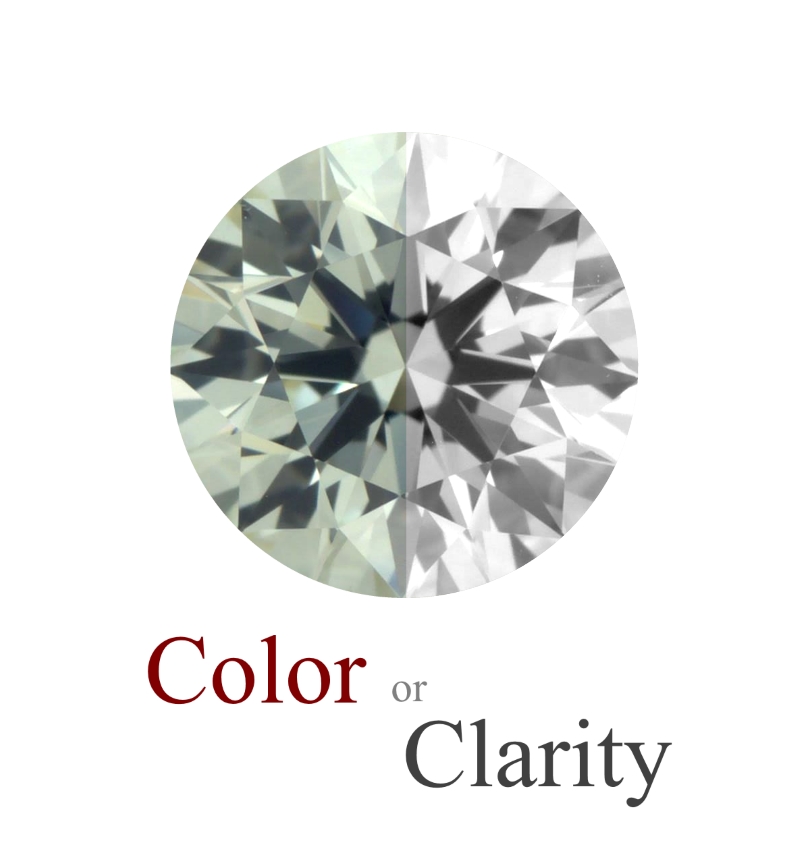
Most diamonds found in the earth are not perfect – they have yellow and brownish tints or they have visible internal flaws that make a stone look unclean. These problems, however, can be treated using a variety of enhancement methods.
Let’s see what the most common diamond treatments are and how they can improve color and clarity.

What Are Clarity-Enhanced Diamonds?
Clarity-enhanced diamonds are diamonds that have been treated with heat or certain substances to make these stones look clearer than they naturally are. Diamonds that have undergone such treatment are real diamonds, but some of their most visible flaws have been removed or masked.
How Is Diamond Clarity Enhanced?
There are two main ways to enhance the clarity of diamonds: laser drilling and fracture filling.
Laser Drilling
Laser drilling is a way to enhance the clarity of a diamond. The process involves using laser to drill tiny holes (thinner than a hair) in the stone, all the way from its surface to an inclusion inside. This channel is then used to remove the inclusion by either melting it with heat or dissolving it with acid. Laser drilling is usually used to remove more obvious inclusions such as black spots.
How Much Can Laser Drilling Improve Clarity?
Most often, the clarity improvement that can be seen in a laser-drilled diamond is about one grade up. For example, if you have a stone that is graded I1, laser drilling can remove some of the more visible inclusions, bumping the diamond’s clarity up into the SI range (turning the diamond into an SI2 or SI1 stone).
It is rare to see an improvement of more than two grades. It’s not that it is impossible to see such a jump, but it comes down to a tradeoff between looks and sturdiness: The bigger the clarity improvement, the more drill holes it entails, and the more channels drilled in the diamond, the weaker its structure becomes.
Here you can browse a selection of loose diamonds that don’t have any clarity enhancements.
A Note of Caution: Laser Drilling May Be Undisclosed
In the U.S., the F.T.C. does not require an explicit disclosure of laser drilling enhancements when diamonds are sold. The logic behind this is that the change in clarity is permanent: If you buy an enhanced diamond that was improved from SI2 to SI1, it remains an SI1 stone forever.
Disclosure regulations can always change, but you as a customer should do the best to protect your interests. Ask explicitly and check if the diamond you are going to buy has been laser-drilled, even if there’s no mention of such a treatment in writing.
But why is it so important to know if a diamond has been treated this way? Well, it turns out that laser drilling can sometimes cause problems.
Related: Here you can browse diamond rings and customize your own ring.
Potential Problems with Laser Drilling
Drilling tiny channels within a diamond weakens its structure, even if this effect is not significant. In most cases, diamonds that have been laser drilled hold up well as long as the drill holes are not too numerous. The problem with durability becomes more serious when there are a lot of tunnels drilled in the stone. You should remember that removing an inclusion this way not only leaves a channel within the diamond but also creates an empty space where the removed inclusion was.
In general, be wary of diamonds with too many drill holes. If you happen to buy such a stone, keep in mind that you should protect it more carefully against accidental hits or bumps, which may cause the diamond to crack or chip.
How to Tell If a Diamond Has Been Laser Drilled
The easiest way to find out if a diamond has been laser drilled is to look at its certificate. A diamond report issued by the G.I.A. (Gemological Institute of America) will list the drill holes in the stone, if there are any.
If you don’t have a certificate, or if you just want to inspect the stone yourself, you can always ask to see the diamond under a microscope. Such an examination will allow you to see firsthand how many channels are drilled in the stone you are about to buy.
Fracture Filling
After the clarity of a diamond has been enhanced through laser drilling, the channels and the empty space that are left after the inclusions have been removed are filled with a crystalline, glass-like substance. This treatment is called “fracture filling.” The goal of this procedure is to make the traces from laser drilling less visible by masking the remaining cavities, making the diamond look better.
The problem with fracture filling is that it is not permanent. The material used to fill the tunnels can melt or break if a jeweler uses heat to repair your diamond jewelry. Not to mention that once a diamond is fracture-filled, it should not be put in an ultrasonic cleaner as it can damage the filling.
Another issue with fracture filling is that the injected substance in the diamond reflects light differently and can change the stone’s sparkle or even alter its color.
A problem worth mentioning is that if you have a laser-drilled or fracture-filled diamond and decide to sell it, many jewelers will not buy it because they prefer not to carry treated stones.
Re-cutting
While not strictly considered a diamond enhancement in the way fracture filling and laser drilling are, re-cutting is another way to improve the clarity of a diamond. This means that the jeweler will simply take the stone and cut some material from all sides, removing some of the inclusions of the diamond in the process.
The problem with this solution is that it reduces the carat weight of your diamond and you end up with a smaller and cheaper stone. Needless to say, this method works if the inclusions are mostly close to the surface of the stone; if they are towards the center, you can’t really cut them out.
Clarity-Enhanced vs. Untreated Diamonds: What Is The Difference?
In general, clarity-enhanced diamonds are cheaper than stones of similar clarity but without any treatments. There are also some other differences in appearance and durability.
Click here to browse a collection of natural diamonds without any clarity enhancements.
Laser-Drilled vs. Untreated Diamonds
The channels in a laser-drilled diamond can make its structure weaker compared to that of an untreated stone. If only a small number of inclusions are removed, the resulting channels won’t be numerous and are unlikely to cause problems. However, if the stone is heavily included and a lot of tunnels are drilled in it, the diamond may become easy to crack.
Not all vendors disclose that a diamond has been laser-drilled. However, the tiny channels can be seen if you look at the stone under a microscope. If the diamond has been certified by the G.I.A. (Gemological Institute of America), the grading report of the stone will contain information on whether it has been drilled.
Related: Browse a selection of customizable diamond rings.
Fracture-Filled Diamonds vs. Untreated Diamonds
Laser-drilled diamonds whose channels have been filled do not look much different from regular diamonds at first glance. However, since the crystalline filling has different refractive properties from those of diamond, the sparkle and color of the stone can be somewhat altered, especially if the filled channels are numerous.
A more important difference is that fracture-filled diamonds are more vulnerable to high temperatures, which can destroy the filling. This is why repairing jewelry with such stones can be tricky if the jeweler needs to use heat.
In addition, fracture-filled diamonds should not be cleaned in ultrasonic cleaners because they can damage the filling of these stones.
Note: Because of the impermanent nature of its results, fracture filling has to be disclosed by the vendor for diamonds sold in the U.S.
What Are the Pros and Cons of Clarity-Enhanced Diamonds?
Pros of Clarity-Enhanced Diamonds
The most obvious pros of enhanced diamonds are their relative affordability and improved looks.
Affordable Price
The biggest advantage to buying clarity-enhanced diamonds is their price. A stone that has been treated to improve clarity can cost 20-30% less than an untreated diamond of the same clarity grade. So, if you consider enhanced diamonds, you can get a pretty good deal on a stone with the clarity grade you are looking for.
Improved Appearance
Clarity-enhancing techniques can remove some prominently located flaws and turn a stone that has one or more visible inclusions into an eye-clean diamond. Coupled with the bargain prices such stones are usually sold at, this improvement in appearance can be considered pretty good value.
Cons of Clarity-Enhanced Diamonds
The biggest potential issues with treated diamonds are related to durability, endurance, and altered appearance.
Potential Durability Issues
One problem with diamonds enhanced through laser drilling is that the tunnels created in the stone can undermine its durability. This is usually not a problem with diamonds that have had only a few inclusions removed. However, low-clarity diamonds that have had numerous and big inclusions cleared off through laser drilling can end up with a lot of tunnels, which could weaken the structure of such stones.
Natural diamonds: Click here to browse natural loose diamonds without any enhancements.
Fracture Filling Is Not Permanent
Diamonds that have been laser-drilled and whose channels have then been filled with a transparent substance should not be subjected to high temperatures or ultrasonic cleaning. Otherwise, the crystal filling could be destroyed. This is actually one of the biggest downsides of fracture filling – its results are not permanent.
Diamond Brilliance and Color May Be Affected
Another disadvantage of fracture-filled diamonds is that the filler can affect their brilliance or color. Since the glasslike filling substance has refractive properties that are different from those of diamond, the filled tubes reflect light differently and can thus create some odd optical effects (such as unusual colors in the stone’s sparkle).
Clarity-Enhanced Diamonds Are Hard to Resell
Unlike untreated diamonds, which can often be resold or exchanged for another stone, clarity-enhanced diamonds cannot be sold or traded in as easily once bought. Many jewelers do not want to carry treated stones, especially if they have been fracture-filled.
Color-Enhancing Diamond Treatments
High-pressure, high-temperature treatment (HPHT)
One of the techniques used to turn diamonds with a brownish tint into colorless stones is heating them under high pressure.
HPHT treatment is permanent, and the color of stones treated this way does not revert to its original state.
This type or enhancement can be hard to detect even with sophisticated equipment, and the F.T.C. (Federal Trade Commission) requires HPHT treatment to be disclosed.
Grading reports issued by the G.I.A. (Gemological Institute of America) will mention HPHT treatment, but only if it has been detected by the lab.
Sometimes, diamonds will also have a laser inscription indicating HPHT treatment. However, an enhanced stone will not necessarily have such an inscription or a mention of the treatment in its certificate.
Coatings
Another method to make the color of a diamond look better is to cover the stone with a dye or thin film that masks the tint of the diamond and can even make fake stones harder to detect.
The coating is not permanent and can usually be removed with water or alcohol. Unless the use of such coatings is disclosed, selling diamonds treated this way is tantamount to deception.
Irradiation
Unlike other color-treatment methods that are used to make a diamond look colorless, treating diamonds with radiation is meant to turn them into fancy-colored stones.
The results of irradiation are permanent. However, in some cases, the color may change if the stone is subjected to high temperature (e.g., during jewelry repairs).
Naturally colored diamonds are rare and therefore very expensive, and that’s why irradiation is used to produce affordable colored stones.
However, there may be some vendors who will try to sell a treated fancy-color diamond as a natural one and charge you a very high price for it.
Or, some people may try to sell you a “natural” stone (that is actually treated) at a price lower than what real natural diamonds sell for. Be suspicious of such offers, and always ask for a certificate issued by a reputable lab.
A Note on Buying Enhanced Diamonds
If you are about to buy a diamond, you should keep in mind that since fracture filling is a treatment that is considered impermanent, the seller is obligated to disclose it to the customer.
On the other hand, if a diamond has undergone only laser drilling, this enhancement is not required to be explicitly disclosed as it is deemed to have a permanent effect.
However, laser drilling is indicated on the diamond grading reports issued by the GIA – the laser drill holes on the stone are listed there, so if you want to find out whether a diamond has been enhanced, ask to see its certificate.
From the GIA:
GIA does not issue grading reports for any diamond that has undergone a treatment process that’s considered nonpermanent or unstable, such as coating or fracture filling.
GIA will issue reports for diamonds that have been laser drilled or HPHT processed, disclosing the presence of treatments on the report.
Where to Buy Diamond Jewelry?
We recommend James Allen (read review) because you can see a 360-degree video for any diamond before buying it.