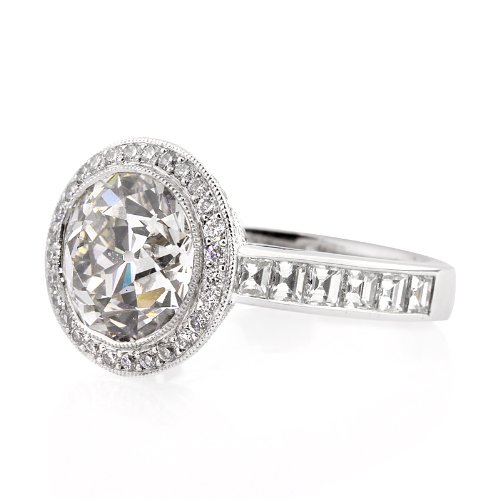
The difference between solid-gold and gold-plated jewelry is related to metal composition: While solid-gold jewelry is made of a gold alloy that is consistent throughout the piece, gold-plated pieces are made of a non-gold metal that is just covered with a thin film of gold.
Gold Plated Jewelry Markings

Looking at gold markings is one of the fastest ways to establish what your jewelry is made of.
Looking at gold markings is one of the fastest ways to establish what your jewelry is made of.
The most common stamp used in gold-plated jewelry is GP (standing for “gold plated”).
You may also see GEP, which means “gold electroplated” and RGP (meaning “rolled gold plate”).
HGE (for “heavy gold electroplate”) is another mark that indicates gold plating (you can also see HGP, which has the same meaning).
Please note that not having such markings does not mean that your jewelry is solid gold: It may simply not be stamped despite being plated.
Acid Testing: The Most Reliable Method
Perhaps the most reliable way to find out the gold content of jewelry is to do an acid test.
Although you can buy an acid testing kit and perform the test at home, interpreting the results can get tricky depending on the gold alloy examined. This is why we recommend that you have such a test done by a professional.
Here’s how acid testing works:
The jeweler will take some sample material from your jewelry and then apply acid to it to observe if there is a color change, which will indicate what metals the sample contains.
Acid testing is used mainly to determine the karat of solid gold jewelry, but it can also indicate whether the piece is plated.
It’s also useful to know that many gold-plated pieces are coated with 24/22/20/18-karat gold, so if you come across an item whose surface acid-tests like 24, 22, 20, or 18 karats but the price is too cheap for that karat, then the jewelry is probably plated.
Alternatively, if you scratch a plated piece deep enough, you will see the underlying metal, which will confirm that the jewelry is not solid gold — try this on your own risk, though.
Note: Solid gold does not mean pure. You should keep in mind that solid pieces consist of an alloy of gold and other metals, and the purity of this mixture depends on how much gold it contains. A piece can be made of solid gold and have very low gold purity at the same time (purity is indicated by the piece’s karat).
Magnet Testing
Another way to test what metals you jewelry contains is to use a magnet. Since gold is not magnetic, if your jewelry is attracted to the magnet, the piece must contain some other metal.
This test, however, is not conclusive for a couple of reasons.
First, while a reaction of your jewelry to the magnet indicates that the piece is not made solely of gold, this does not necessarily mean that it is plated – it can still be a solid gold alloy that has low purity and contains a magnetic metal.
Second, a piece may be gold plated without being attracted to a magnet if the core metal, which is covered with gold, is nonmagnetic.
The magnet test is not completely useless, however: Used in conjunction with other tests, it can give you some clues about what your jewelry is made of.
Gold Color as an Indicator
The color of your jewelry can also be used as a clue to whether the piece is solid or plated.
Gold-plated jewelry is sometimes covered with 24-karat gold. In contrast, solid gold pieces are not made of pure gold as it is too soft; they are instead made of a gold alloy that contains metals that give the mixture hardness.
So, if your jewelry has an intense yellow color similar to that of pure gold and is relatively cheap (or its price is close to that of identical 10K or 14K pieces), then it may be gold plated.
The best way to know that for sure, however, is to have the piece acid tested.
You can also look at the surface of the jewelry and see if its tone is even throughout or there is a change in color somewhere: If the gold plating is worn off in some places, the underlying metal will be visible there.
Should You Buy Gold Plated Jewelry?
Gold plated pieces are usually cheaper than the ones made entirely from gold. So, if money is an important consideration, you might want to go with plated jewelry.
Downsides of Plated Jewelry
As you might expect, picking the cheaper option also has its disadvantages. For starters, the plating that covers your jewelry will inevitably wear away. The thicker the outer layer, the more time it will take before it wears away and the lower layer becomes visible.
At that point, you can take the piece to your jeweler to get it replated. The problem with replating is that it costs money and some metals, such as gold or rhodium (for white gold), are very expensive.
You should also keep in mind that the more moving parts a jewelry piece has, the harder it is to plate it again. Be wary of buying such items plated.
If you are comfortable with the thought that the plating will wear away at some point, you should also know that it’s hard to predict when this will happen.
How long the plating will stay intact will depend on its thickness, how frequently you wear the piece as well as its design.
When to Buy Gold Plated Jewelry
Plated jewelry has its shortcomings, but that doesn’t mean you shouldn’t buy it; you should simply be aware of its limitations when making a purchase decision.
It is best to buy plated pieces of jewelry if you don’t intend to wear them every day.
If, for example, you need a gold ring that you will wear only occasionally, you might as well go with gold plated.
However, if you are sure that you will wear it all the time, it may be a good idea to pick something more solid because in this case, a plated piece would wear away very quickly.
Before buying plated jewelry, make sure that you are informed of all metals it contains, especially when it comes to the layer under the plating.
If you are allergic to nickel and the lower layer is made of an alloy that contains the metal, as soon as the plating wears away, your skin will be exposed to the allergen.
Choose carefully, and be sure to ask how the piece is made and what its contents are.
Where to Buy Gold Jewelry?
For jewelry with diamonds, emeralds, rubies, or sapphires, we recommend James Allen (read review) because it allows you to take a 360-degree look at any stone before having it set in gold.