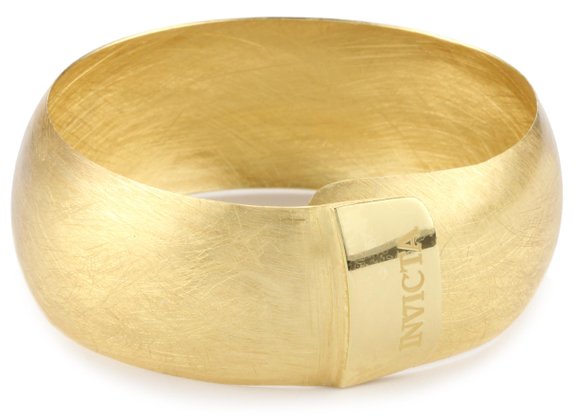
What Is Gold Plating?
Gold plating refers either to the thin layer of gold that covers the surface of gold-plated items or to the process through which this coating is applied. The core of such pieces can be made of a variety of non-gold metals, and the gold with which they are covered can be of different levels of purity.

Gold vermeil necklace pendant
What Is Gold Vermeil?
Gold vermeil, or just vermeil, is a term used to refer to jewelry or other items made of silver and coated with gold. The word “vermeil” comes from French and is pronounced “ver-may.”
An alternative term is “silver-gilt” (or “gilded silver”), which has the same meaning as “vermeil.”

Vermeil is a term used to refer to jewelry or other items made of silver and coated with gold.
How Gold Vermeil Is Made
Vermeil jewelry is made by first creating the base of the item out of silver and then plating it with a thin layer of gold. The method used to cover the surface of the piece with gold is called electrolysis.
Gold vermeil can be made with gold of varying purity, but in the U.S., there is a minimum requirement: To be considered vermeil, a piece needs to be plated with gold that is at least 10 karats (which corresponds to approximately 42% gold content).
Further, U.S. regulations state that an item cannot be sold as vermeil unless its gold plating is at least 2.5 microns thick (0.0025 millimeters). Also, if the core of the piece contains another metal besides silver, this should be disclosed by the seller.
Differences Between Vermeil and Gold-Plated Jewelry
The most notable difference between vermeil and gold-plated pieces is in the metals that make up their base. Differences in price or in the thickness of the plating can also exist, but they are not consistent, as they are not always in the same direction.
Core Metals
The core of gold-plated items can be made of different metals, and there is no restriction saying that a particular metal needs to be used.
In contrast, gold vermeil should always be made with silver as the main metal used to create the core. Otherwise, the piece cannot be sold as vermeil. This requirement is the biggest difference between general gold-plated items and vermeil pieces.
Plating Thickness
In the U.S., there is a minimum thickness requirement for the plating on gold vermeil – as already mentioned, the gold coating needs to be at least 2.5 microns, or 0.0025 millimeters.
CLEARANCE DEAL: Save up to 50% on jewelry from James Allen!
There are no such requirements for gold-plated items. Their plating can vary in thickness, and no minimum value needs to be met for a piece of jewelry to be sold as gold plated.
Price
You can see vermeil pieces that are more expensive than gold-plated ones of similar weight or size.
Part of the reason for this is that vermeil jewelry is made with silver, whereas many gold-plated pieces are made with cheaper metals that are used to create the core under the plating.
However, vermeil items do not always cost more, all else being equal.
You shouldn’t forget that prices of plated items also depend on the thickness of the plating and its karat. And the core of non-vermeil plated jewelry can also contain more expensive metals, including silver.
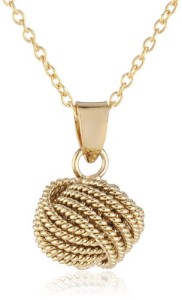
Gold-plated pendant necklace
Which Is More Durable – Vermeil or Gold-Plated Jewelry?
The durability of vermeil and gold-plated jewelry depends mainly on the karat of the gold plating, its thickness, and the composition of the alloy used to make the core.
Silver is a soft metal, and this is why you can expect a vermeil piece to be relatively easy to bend unless its core contains other metals that improve its hardness.
Whether a gold-plated piece would be harder (compared with vermeil) depends on the metals it is made up of – some items may not be much harder than vermeil.
The karat of the gold plating will determine whether its surface will be easy to scratch – higher-karat gold is softer and less durable, whereas lower-karat alloys do not scratch and wear out as easily.
In this respect, a vermeil piece can be more or less durable compared with a gold-plated item depending on the gold used to plate each piece.
As for the thickness of the plating, you can have a vermeil piece whose gold layer is thicker than that of a gold-plated piece, or the situation could be reversed.
Whichever the case, the thicker plating is likely to last longer (provided that it is not much softer because of its karat).
As you can see, neither vermeil nor gold-plated jewelry is undisputedly better when it comes to durability – you just have to judge it on a case-by-case basis considering the karat of the plating, its thickness, and the composition of the core.
Vermeil, Nickel Content, and Allergies
In general, if you are wearing vermeil, you shouldn’t be worried about allergic reactions to nickel as this type of jewelry usually does not contain the metal. However, if the base of the piece does contain nickel and you are allergic, it can give you a rash if the plating wears off.
Remember: If a vermeil item contains nickel, in the U.S., the vendor is required to disclose this, so don’t forget to check if you are concerned about an allergy.
Markings for Vermeil and Gold-Plated Jewelry
Gold-plated jewelry is usually marked with one of the following symbols: GP, RGP, GEP, HGP, or HGE.
If you see one of these letter combinations after the karat number of the gold (as in “14K GP”), then this is an indication that the piece is gold plated.
A vermeil piece might not be explicitly marked with a stamp indicating that the jewelry is plated with gold, but if you see a stamp denoting a standard silver purity value on a gold surface, then it is very likely that the piece has a silver core.
For example, the mark “925” stands for 92.5% silver content, and seeing it on gold usually means that the item is actually made of a 92.5% silver alloy that is plated with gold.