


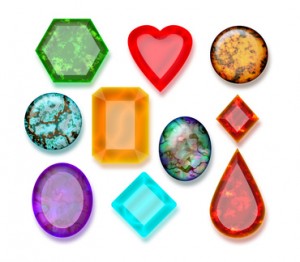
Assorted colored gemstones
Perhaps you already know that clarity is one of the four elements that determine diamond quality, but what about other gemstones? You certainly want to make sure that their color is what you are looking for, but should you also look at clarity and how?
Gemstone Clarity Grading
Like diamonds, other gemstones are also graded on clarity. And the principle behind the grading process is the same: the fewer inclusions a stone has, the better the clarity grade.
However, non-diamond gemstones are not evaluated according to a widely accepted clarity scale. Different jewelers use different methods, but the concept behind all those scales is the same.
You as a customer should care about how many inclusions a stone has and how visible they are, right? Actually, it’s not that simple with colored gemstones.
Why Less Clarity Can Be a Good Thing
The connection between clarity and quality in colored gemstones is not as straightforward as in diamonds. With diamonds, fewer inclusions mean better sparkle.
However, diamonds are also preferred colorless, while most other gemstones are bought for their color.
And the interesting part is that colored gemstones get their color from various chemical elements within their structure, which are seen as inclusions.
So, it turns out that the inclusions that obfuscate the clarity of gemstones also give them their color. If you want an intensely colored gemstone, it will probably have more inclusions.
The relationship between clarity and color varies for different gemstones, and that’s why you need to decide on a case-by-case basis whether you like the way the stone looks or not.
As a general rule, go for higher clarity as long as you are comfortable with the gemstone’s color intensity.
Synthetic Gemstones
Gemstones created in a lab are often very high in clarity. If the stone you are looking at seems too clear and perfect, it may actually be a synthetic gem.
Price may also give you a clue, as artificial gems are usually cheaper.
So, if in doubt, always ask whether the stone is genuine. After all, you don’t want to buy a fake at the price of a real stone.
What to Look For When Buying Gemstones
The exact criteria to evaluate gemstones vary by type, but there are a few general tips that apply to all.
First, make sure you like the color and clarity of the stone. Keep in mind that the bigger the stone, the more visible its inclusions will be when worn.
Once you’ve made up your mind about the basics, take a closer look at the gem, and see if there are any signs of damage on its surface and inside.
Make sure that the stone is not chipped, as any chips would weaken its structure.
Also, there shouldn’t be any cracks within the gemstone. Any damage to its structural integrity may cause your stone to break more easily if hit.


