Finding a Cheap Heart-Shaped Diamond
The price of a heart-shaped diamond is mainly determined by four most important criteria – clarity, color, carat, and cut.
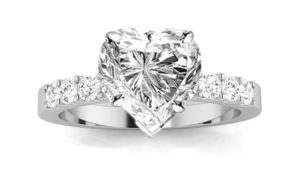
Heart-cut diamond ring
So, to find a cheap stone, you should have relatively lax requirements as to one or more of these price factors.
Choosing Affordable Diamond Clarity
The clarity of heart-shaped diamonds is graded in the same way as that of other diamond cuts – according to how many visible flaws (inclusions) there are in the stone.
On the scale used by the GIA (Gemological Institute of America), the top grade is FL (Flawless) and the bottom grade is I (Included).
When picking a ring with a heart-shaped diamond, you don’t need to go for the highest clarity, as there are lower clarity grades that are cheaper and equally clean to the naked eye.
It is recommended, though, that you don’t go below the SI (Slightly Included) clarity range, which is the level above I-clarity.
Usually, SI1-clarity heart-shaped diamonds are reasonably clean. SI2 clarity is a borderline grade – some diamonds have visible flaws, but if the inclusions are in locations that could be hidden by the ring’s setting, you might be able to save even more money on clarity.

SI2-clarity heart-shaped diamond
You can go one grading range higher and check out diamonds graded VS1 or VS2 (VS stands for Very Slightly Included) in case you cannot find SI1-clarity stones that look clean enough.

VS1-clarity heart-shaped diamond
Selecting a Cheaper Diamond Color
On the GIA scale, diamond color is graded using letters, from D (highest color quality) to Z (lowest quality).
Heart-shaped diamonds have lower brilliance than round diamonds, and this is why yellow tints in heart-shaped diamonds are more visible. This means that you shouldn’t go lower than G or H color if your ring is made of platinum, white gold, or silver.
For yellow gold rings, your heart-shaped diamond shouldn’t have a color grade lower than I or J, or the stone may look visibly yellowish.

G-color heart-cut diamond

J-color heart-cut diamond
Choosing a Lower Carat
When selecting a heart-shaped diamond, keep in mind that the bigger a diamond, the more expensive it is per carat.
Also, if you choose a bigger stone, you should pay more attention to its clarity and color grades, as imperfections in these characteristics become more noticeable with size.
So, if you want to find a cheap heart-shaped diamond, go for a smaller-carat stone. Do not buy a diamond that is too small, though, as the shape of these stones is less discernible and looks more round or oval than heart-like.
Selecting Cut for Your Heart-Shaped Diamond
Cut is an important characteristic of a diamond, as the stone’s proportions determine how much brilliance the diamond will have. This is why we do not recommend saving money by buying poorly cut diamonds – such stones tend to have little sparkle, look drab, and their flaws are more visible.
There is no universally accepted standard for ideal cut proportions for heart-shaped diamonds. However, there are some rough guidelines to help you make sure that the cut of your stone is good enough.
Ideally, the length-to-width ratio of a heart-shaped diamond should be close to 1. The recommended acceptable range for a well-shaped stone of this cut is between 0.85 and 1.10.
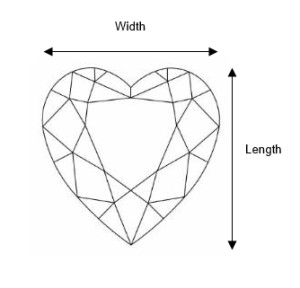
The girdle (outer edge) of your heart-shaped diamond should not be too thin or too thick. If there is a culet (a flat facet on the bottom of the stone instead of a sharp end), it should be small; if it is too big, it will be visible through the top of the diamond.
The width of the table (the diamond’s flat top) of a heart-shaped diamond should ideally be between 52% and 65% of the total width of the stone.
The depth of the diamond, as measured by the vertical distance between its top facet and its bottom, should be between 53% and 70% of the stone’s width.
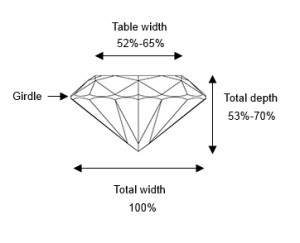
Recommended proportions for the heart cut
Choosing a Cheap Band
The band is the other component that affects the price of a heart-shaped diamond ring. To find one that is cheap, look for bands made of cheaper metals.
For example, white gold is cheaper than platinum, as is yellow gold, and the lower the karat of a gold ring, the less expensive it is. Another cheap metal is silver.
You should also consider the size of the ring’s band, as wider and thicker rings contain more metal and are more expensive. To minimize the cost of the ring, choose a band that is relatively thin and narrow. Keep in mind, however, that such rings are easier to bend.
Another factor affecting price is the design of the ring – the more intricate ornaments it has that are complex to make, the more expensive it will be. If you are looking to save money, go for plain bands.
Selecting a Setting for a Heart-Shaped Diamond Ring
When buying a heart-shaped diamond, make sure its setting protects the pointed end of the stone. This end is vulnerable to chipping, so it is best if it is not exposed to accidental hits.
If you are buying a ring with a prong setting, the sharp end should be protected by a prong, ideally a V-shaped one.

The sharp end of this heart-shaped diamond is protected by a V-prong.
Where to Buy a Diamond Ring?
We recommend James Allen (read review) because you can take a 360-degree look at any stone before having it set in a ring.
Blue Nile is another reputable diamond retailer we recommend.