Origin
Cubic zirconia is made of zirconium dioxide. It is produced synthetically and is one of the diamond imitations that are closest to the real thing in terms of appearance.
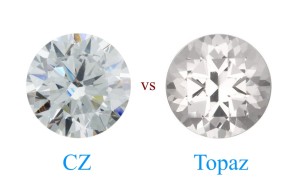
White topaz is a variation of the silicate mineral topaz, which occurs in different colors.
Unlike cubic zirconia, which is synthetic, white topaz is natural.
Color
Both white topaz and cubic zirconia are colorless. Since white topaz is natural, it may contain some impurities that can affect its color.
Cubic zirconia, on the other hand, is created in a lab and is usually perfectly colorless.
Clarity
Since white topaz is a natural gemstone, it can have some internal imperfections that developed during its formation. Some stones may have easily visible inclusions, while others may look flawless to the naked eye.
Compared with other gems, this stone is relatively clean, though, and tends to have a glassy appearance.
Compared with white topaz, cubic zirconia usually looks cleaner. This is due to its artificial origin – the methods used to synthesize cubic zirconia minimize potential defects, and as a result, this stone looks perfectly or nearly flawless.
Sparkle and Fire
Many colorless and colored gemstones tend to sparkle when exposed to light, but some types tend to exhibit more colorful flashes than others. This flashing effect is known as fire.
Cubic zirconia tends to have more fire than white topaz. However, keep in mind that the excessively colorful flashes of cubic zirconia also distinguish this stone from real diamond, whose fire has less color.
Durability
Cubic zirconia is relatively hard and is graded 8.5 on the Mohs scale of hardness.
However, this stone does not come close to diamond in terms of durability (diamond is a 10 on the Mohs scale). This means that cubic zirconia is easier to scratch than diamond.
White topaz is close to cubic zirconia in terms of hardness (8 on the Mohs scale), but it is softer.
Although neither of these stones is as hard as diamond, white topaz is easier to scratch or break, and its color is more easily affected by high temperatures.
So, if you are looking for durability, cubic zirconia is the better choice – it will last longer, and its facets will not wear down as fast as those of white topaz.
Price
Although gemstone prices vary depending on clarity, size, and other factors, cubic zirconia and white topaz are relatively cheap.
Both stones cost a fraction of the price of a real diamond, so they are quite comparable when it comes to affordability.
This is why it is best to choose between the two based on appearance and durability, and consider price as a secondary factor.