What Is a Diamond Simulant?
Diamond simulants, or simulated diamonds, are stones that look like real diamonds but have different chemical composition and physical properties.
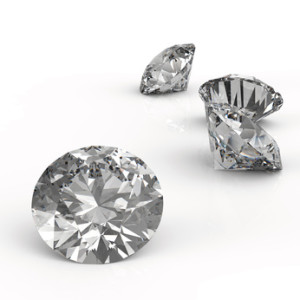
Simulated diamonds are a popular alternative to real diamonds.
Simulants are, in essence, fake diamonds.
They should not be confused with synthetic diamonds, however, which are identical in any way to natural diamonds except in that synthetics are created in a lab.
How to Tell a Simulated Diamond from a Real Diamond
Here are the signs a stone is a diamond simulant:
It looks too clean.
Even the most flawless diamonds have some internal defects.
Some of these flaws are not visible with the naked eye, and you may have to use a loupe or microscope to see them, but no natural diamond is without imperfections.
Diamond simulants, on the other hand, are often very clean (especially those created artificially) but much cheaper than real high-clarity diamonds.
It retains heat.
A real diamond dissipates heat very quickly. Therefore, if you breathe on it, a real diamond will not remain foggy.
If a stone retains some moisture in the form of fog on its surface after you do this breath test, then you most likely have a diamond simulant.
It scratches easily.
Diamond is a very hard substance, and although it can be chipped if hit really hard, it is not easy to scratch it.
Simulated diamonds, in contrast, are never as hard as the real thing, and they can be scratched relatively easily, especially if the simulant is made of a softer substance.
If it doesn’t take a lot of effort to scratch a stone, or if it has a lot of scratches already, then it is most likely a simulant.
Its sparkle is too colorful.
Real diamonds have sparkle, but some simulants have it in excess.
There are simulated diamonds that sparkle in all colors of the rainbow. One such example is cubic zirconia, which when put next to a real diamond exhibits much more colorful flashes of light.
The stone is colorless, but its price is low.
Real colorless diamonds are very rare and therefore quite expensive.
If a stone is white, without a hint of yellow, and if it is relatively cheap, especially if it is also flawless and big, then it is almost certainly a diamond simulant.
It is cheap.
Simulants are cheaper than real diamonds, and although diamond prices depend on a variety of quality characteristics, you are not likely to find a good and well-cut diamond that is around one carat for less than a couple of thousand dollars.
If a stone is reasonably big and colorless, looks clean to the naked eye, and its price is in the hundreds, then it is likely a fake.
Common Diamond Simulants
Here are some of the more popular diamond substitutes: cubic zirconia, zircon, moissanite, synthetic garnet (you can see it abbreviated as YAG and GGG, which are different variations of lab-grown garnet), spinel, rutile, white sapphire.
Trademarks such as DiamondAura or Diamonique can also indicate that the stone is a simulant (unless they indicate a synthetic diamond that has the same chemical composition as real diamond).
So, if you see or hear any of these names mentioned by a jewelry vendor, you should know that you are dealing with a diamond simulant.
Diamond Simulants vs. Real Diamonds
When comparing a simulated diamond with a real diamond, you should focus on how they are similar and different in terms of their most relevant characteristics: clarity, durability, brilliance, color, and price.
Clarity
Diamond clarity refers to how many visible imperfections there are in a stone, as well as how prominently they are located. It is natural for diamonds and other gemstones to have such flaws.
The most common simulated diamonds have higher clarity than real diamonds. This is because these simulants are usually created in a lab, in a process designed to reduce as much as possible the number of inclusions (flaws) in a stone.
Some of the simulated diamonds created synthetically are cubic zirconia, most of the moissanite available on the market, synthetic garnet, and synthetic rutile, among others.
Clarity can help you recognize a simulant – if a stone is too clear and is also pretty cheap compared with similar-clarity diamonds, then it is most likely simulated.
(Synthetic diamonds are also clean, but their prices are close to those of natural diamonds, not a fraction of them.)
Durability
Diamond is the hardest gemstone, and any simulant cannot really compete with it in this respect. This is why you should expect simulated diamonds to be less durable than the real thing.
For example, cubic zirconia is significantly softer – it is rated at around 8.5 on the Mohs scale of hardness (diamond is a 10), and that’s why it scratches more easily.
Most simulated diamonds are not much harder, if at all – many of them have a hardness rating in the 7.5-8.5 range.
Moissanite stands out as one of the hardest simulated diamonds – its Mohs hardness grade is 9.5. White sapphire is a close second – it is graded 9.
So, if you see a stone that has accumulated a lot of scratches and whose edges are smooth instead of sharp, you most likely have a simulant – real diamonds don’t wear and scratch in such a way.
Brilliance and Sparkle
Many simulated diamonds are no less brilliant than real diamonds. For example, cubic zirconia and moissanite have a lot of brilliance, and their sparkle is greater than that of diamond.
The brilliance of simulants differs from that of real diamonds, however. If you look at the two examples mentioned above – moissanite and cubic zirconia – you will see that their sparkle is more colorful compared with that of diamond.
Abundant brilliance and colorful sparkle are some of the giveaway signs of a simulant – if when compared with a real diamond, a stone sparkles in visibly more colors, then it is likely a simulated diamond.
Color
Most simulated diamonds are similar in color to real diamonds – i.e., reasonably white, or more precisely, colorless.
(By the way, most natural diamonds are yellowish in color, and those that have no such tints are very rare and therefore expensive.)
Some simulants can be quite colorless. For example, you can find cubic zirconia or white sapphire that has no yellowish hues.
Other simulated diamonds, although with a decent color, cannot match the most colorless diamonds in this respect.
For example, moissanite tends to have some yellow tints – they can be very subtle but are still stronger than what you would see in diamonds of the highest color grade.
Price
One of the biggest differences between simulants and real diamonds is price – simulated diamonds are much cheaper, often selling at a fraction of the price of a real diamond.
This is also one of the ways you can tell that you are being offered a simulant – if the price of a stone is much lower than that of an equally big diamond that looks similarly clean and colorless, then the cheaper stone is most likely not a diamond.
Where to Buy Diamond Jewelry?
We recommend James Allen (read review) because you can see a 360-degree video for any diamond before buying it.