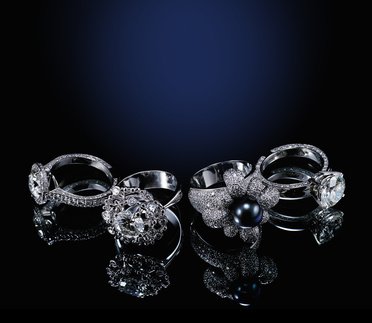
Choosing a setting is important as it determines how securely the stones will be held in place, how visible they will be, and how easy the ring will be to clean and care for, among others.
Here are some of the most popular settings for diamond/gemstone rings:
Prong Settings

A ring with a prong setting
The prong setting is one of the most popular settings for rings. Prongs are basically metal pins that hold the stone in place.
Prong settings are usually made with four or six prongs. There are also designs with eight prongs. In general, the more prongs a setting has, the safer it is, as there are more prongs that keep the stone from falling off the setting. Fewer prongs make a setting less secure, but they also make the diamond or gemstone more visible.
Pros: Prongs take up a small area of the stone and leave most of its surface visible. This is especially important when it comes to diamonds, as their brilliance depends on how much light can enter them and be reflected back.
Cons: A problem with prongs is that sometimes they can catch on clothes or hair. This usually happens when the prongs are worn out or loose – in such cases, prongs get bent and stick out. To avoid this, have your prongs regularly inspected every couple of years and get them repaired or tightened if needed.
If the wearer is going to wear the ring every day, or if she works with her hands or engages in vigorous activities, a prong mounting in which the stone is set lower and closer to the shank is a safer choice as opposed to a mounting that is set higher and farther away from the shank.
The Tiffany Setting
The Tiffany setting is a type of prong setting. It has six prongs and is designed to enhance the brilliance of the diamond mounted in it by achieving maximum light return. This setting was created by Tiffany & Co. and cannot be reproduced by any other company as the setting itself is trademarked. Many jewelers offer settings that are quite similar in design, however.
Advantages and disadvantages: The pros and cons of this type of setting are pretty much the same as those associated with all prong settings. Please see the section dedicated to prong settings above.
Bezel Settings
The bezel setting is another popular design. This setting holds the diamond or gemstone with a strip of metal that is wrapped around the stone.

A ring with a bezel setting
There are two types of bezel settings – the full bezel setting and the partial bezel setting.
The full bezel setting encircles the stone entirely, along its circumference. This type of bezel setting is the safest, but it also conceals a significant part of the stone.
The partial bezel setting does not cover the entire edge of the stone – it leaves its sides visible. The parts of the stone that are not covered are exposed to potential blows and hits that could be damaging, but more of the diamond or gemstone is visible compared with the full bezel setting.
Pros: The bezel setting provides much better safety in comparison to prong settings. The stone is well protected and is less likely to get damaged when worn.
Cons: The bezel setting hides more of the stone compared to a prong setting. So if you’re buying a diamond ring, for example, you should decide what is more important: the safety or visibility of the stone. As you can see, there is a tradeoff between these two features.
Solitaire Setting

A solitaire ring with a diamond (James Allen)
Solitaire settings have a single center stone. This type of setting is one of the most popular, as it emphasizes the diamond or gemstone mounted in it. Solitaire settings are often made with prongs. There are also many solitaires made with bezels.
Pros: The solitaire setting focuses the attention on the single stone mounted in it. There are no side stones. The ring is simple and easy to clean and maintain.
Cons: Although there are no side stones to distract from the center stone, the lack of additional stones also means forgoing the opportunity to enhance the center stone’s brilliance and sparkle. And smaller stones cost less for the same total carat weight – for example, a 0.50 ct diamond with two 0.25 ct smaller side stones (1.00 ct in total) would be cheaper than a single 1.00 ct diamond of the same quality.
A solitaire ring will have additional pros and cons specific to the kind of setting holding the stone – prong, bezel, or another type of setting. You can read the appropriate sections in this article pertaining to the respective settings for more information.
Tension Setting

A ring with a tension setting
The tension setting holds the diamond or gemstone by pressing it between two metal bands. This pressure is what keeps the stone in its place, and this is also where the name of this setting comes from. Each tension setting is specially designed to fit the dimensions of the stone it has to hold.
Pros: Tension settings look great, unique, and unusual. They provide pretty good visibility for the diamond or gemstone set in them.
Cons: A good and safe tension setting can be complicated and relatively expensive to make since the jeweler has to ensure that the two bands fit exactly the dimensions of the diamond or gemstone. The classical tension setting is also less secure than a typical bezel or prong setting, so the wearer has to be careful not to damage the stone, especially if working with her hands. Resizing the ring or setting a new stone in it can be difficult depending on the setting.
Some of the disadvantages of the classical tension setting are addressed by its modified version – the tension-style setting. This setting looks like the typical tension setting but holds the stone in a bezel or prong setting, which is attached to the two metal bands of the ring. This type of setting is safer than the classical tension setting.
Three-Stone Setting

A diamond ring with a three-stone setting (James Allen)
The three-stone setting is very popular. Most commonly, it has a center stone surrounded by two side stones, which can be smaller or the same size. This setting is a great choice for a diamond ring and for occasions such as a wedding or an engagement. The diamonds or gemstones in the mounting can be held by prongs, bezels, or another type of setting. Read about the pros and cons of each of these settings in the respective sections above.
Pros: The additional side stones in a three-stone setting add more brilliance and sparkle to the ring and enhance the center stone, especially when this stone is a diamond.
Cons: More stones in a ring mean more parts to clean and maintain, so a three-stone setting needs extra attention when it comes to care. Also, if you would like the center stone in the ring to stand out, make sure that the side stones do not overpower it in terms of size, sparkle, or color.
Cathedral Setting

A cathedral setting – side view
The cathedral setting mounts the stone high above the ring’s shank. The diamond is held by arches of metal, and this is where the name of this setting comes from. In a cathedral setting, the center stone itself is usually held with prongs or a bezel. This type of setting is one of the most popular. Many people prefer it for engagement or wedding rings.
Pros: Since mounting the center stone high above the body of the ring puts an emphasis on the stone, a cathedral setting can create the illusion of size and make the diamond or gemstone appear larger.
Cons: Setting the center stone high makes it more vulnerable to potential accidental hits and blows, especially if the wearer does a lot of work with her hands. The added height also makes this setting more prone to catching on clothing or other objects.
Any additional advantages or disadvantages depend on how the center stone is held in the setting – with prongs, with a bezel, or in some other way.
Halo Setting

A diamond ring with a halo setting (James Allen)
The Halo setting is a style in which the center stone is surrounded by smaller diamonds or other stones. You can have single and double halo settings – the former has only one circle of stones surrounding the center stone, while the latter has two.
Pros: The halo setting can increase the overall sparkle of a diamond ring. This setting is a good option if the center stone is small and you want to enhance its appearance. A halo setting can also be a cheaper alternative to buying a bigger center stone – a 0.70-carat diamond surrounded by small diamonds that are 0.30 carats in total would be cheaper than a single 1-carat diamond, all else being equal. This is because bigger stones are rarer and much more expensive.
Cons: Halo settings are somewhat trickier to maintain and clean compared to settings with fewer stones.
Cluster Setting
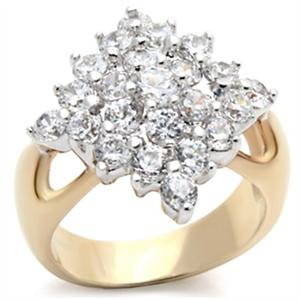
A ring with cluster-set stones
The cluster setting is made up of smaller stones clustered together. It is somewhat similar to the halo setting. A cluster setting can have a bigger center stone surrounded by a cluster of smaller stones, or it can have stones that are all of the same size.
Pros: A cluster setting is a good choice if you cannot afford the price of a bigger center diamond but want additional sparkle at a lower cost. Cluster settings where all diamonds are of the same size can also create the illusion of one bigger diamonds.
Cons: As with the classical halo setting, the main drawback of the cluster setting is that it requires more effort to clean and care for.
Channel Setting
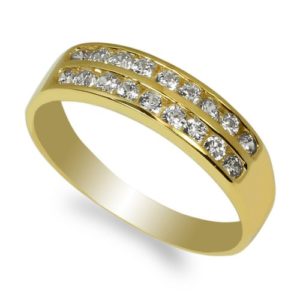
A ring with a channel setting
The channel setting holds diamonds or other stones in a groove, or a channel, in the band of the ring. These stones are smaller and usually serve to complement the bigger center stone, which is usually mounted in another type of setting such as a bezel or prong setting. There are also rings that have only channel-set stones with no center stone.
Pros: The diamonds or gemstones in a channel setting are secure and well protected from accidental hits or blows. The setting doesn’t have protruding parts such as prongs, which could catch on clothes, hair, or other objects.
Cons: Channel settings are difficult to clean, as it is hard to access the area around and behind the stones. Rings with channel settings are also tricky to resize because the resizing process has the potential to distort the channel – that’s why sometimes it is impossible to resize such rings without damaging the channel.
Bar Setting

A ring with bar-set stones
Diamonds or gemstones in a bar setting are placed in a row and are separated by small metal bars. The bar setting resembles the channel setting in appearance, although the two differ in structure. The bar setting is designed to hold smaller stones, which can accentuate a bigger center stone, or there may not be a center stone at all (the latter is a popular design for wedding bands).
Pros: The bar setting provides somewhat better visibility for the stones compared to a channel setting. The setting itself is relatively secure.
Cons: Although this setting is generally safe, it is slightly less so compared to the channel setting, which provides better protection for the stones. Resizing a ring with a bar setting can be tricky.
Pave Setting

A ring with a typical pave setting
The pave setting (pronounced ‘pavei’ – from the French word for ‘paved’) is made with very small diamonds inserted into tiny holes drilled into the ring. The stones are held securely in their place by small droplets of metal placed between the diamonds. The result is a surface studded with small stones which are held at the edges by even smaller prongs.
There is a variation of this setting called “micro-pave,” which is made with diamonds that are even smaller than the ones usually used for pave settings.
Pros: Pave settings provide additional sparkle to a diamond ring, and the visual effect created by this type of setting is striking. The pave setting is a good choice if you have a center stone that is somewhat lower in brilliance and you want to enhance it.
Cons: Some pave settings are not made very well and their stones may not be held fast by the prongs/metal droplets that are supposed to secure them in place. That’s why you should examine a pave setting with a loupe and watch out for bent or uneven prongs, loose stones, or stones that are misaligned and that overlap. Pave-setting rings can also be hard or even impossible to resize if the small stones cover the shank of the ring.
Flush Setting
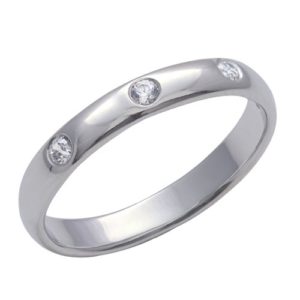
A ring with flush-set stones
The flush setting (also called a gypsy setting) is named this way because the stone is set flush into the ring’s band. The diamond or gemstone is mounted in a hole made in the body of the ring, and the stone fits perfectly in this “nest.”
Pros: The stone is well protected, so this setting is a good option for people who lead an active lifestyle of work with their hands a lot. The risk of damaging or losing the stone is minimized by the sturdy design.
Cons: The flush setting limits the visible area of the stone and can thus reduce the brilliance of diamonds since only their top is visible.
Invisible Setting
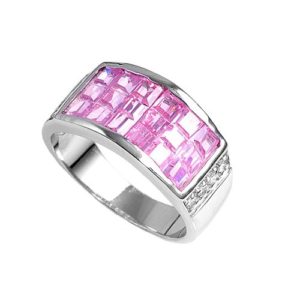
A ring with an invisible setting
In an invisible setting, stones are held by a metal construction hidden underneath them. The result is that there are no visible parts holding the stones in place.
Pros: The invisible setting looks nice, and it also ensures that gemstones/diamonds are well protected from damage, as stones do not stick out from the mounting and are thus less likely to catch on clothing or other objects.
Cons: Although an invisible setting generally protects stones well from damage, there are invisible settings in which stones are not held very securely and can thus fall out if the ring suffers a strong blow.
In addition, many invisible-set stones are held in place by carving small grooves into their pavilions (the lower body of the gemstone/diamond), in which then parts of the metal frame of the setting are inserted. These grooves may lower the price of the stone if it were to be resold as a loose stone at some point in the future (if you’re not planning on doing that, this is not important).
Last but not least, most of the surface of invisible-set stones is not visible, as it is hidden in the setting. Because there is less visible surface through which light can enter the stone and be reflected, the result is less sparkle compared to, say, a prong-set stone.
When buying a ring with an invisible setting, make sure that its stones are held securely, and be careful when wearing it (as you should be with any type of ring).
Vintage Setting (Antique Setting)
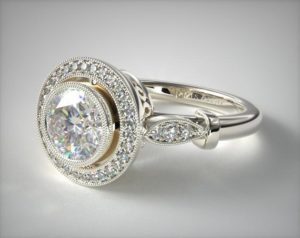
A diamond ring with a vintage setting (James Allen)
Vintage settings/antique settings are designed to feature elements characteristic of a certain period in the past. For example, Art Deco rings have elements inspired by the Art Deco style, which was popular from the 1920s to the 1940s. Other common styles for vintage/antique rings include Victorian, Edwardian, Art Nouveau, and Georgian era styles.
Vintage style settings often include milgrain elements (also known as “millegrain”), which are basically small beads of metal along the edges of the ring. Another type of design common in antique style settings is the filigree. Filigree rings are decorated with small threads of metal to give the piece of jewelry an antique look.
Cocktail Rings
A cocktail ring is a piece of jewelry that is larger than normal rings and is designed to attract attention with its size and colors.

Orange quartz cocktail ring
These rings usually have an oversized center stone or a lot of small stones in their settings. The gemstones in cocktail rings are often imitations. When cocktail rings first became popular around the 1940s, they were worn at cocktail parties, and this is how these rings got their name. Nowadays, cocktail rings are usually worn to all sorts of fancy events, although people also wear them when dressed informally.
Most cocktail rings are made with cheaper materials and are relatively inexpensive. Low-karat gold (10k or 14k) is commonly used. Often, the jewelry is covered with plating, and the layer beneath it is made of a cheaper metal or alloy.
Since the stones used in cocktail rings are usually pretty big, often imitations of diamonds or other gemstones are used – if such a ring were to have the real thing set in it, the piece would cost a lot of money. There are genuine stones used in this kind of jewelry, but they are of the inexpensive type. Cocktail rings made with high-quality materials and gemstones are rare and pricey. There are cocktail rings that have real diamonds, but these stones are usually numerous and tiny, and they also have low-grade color and clarity as well as a poor cut.
Downsides of Cocktail Rings
Since cocktail rings are often made with low-karat gold, most of them are not a good choice for people allergic to nickel, which is commonly found in gold alloys. Another problem with cocktail rings is related to the plating they are coated with – it is usually thin and wears out quickly, exposing the lower layer that has a different color.
While it is clear that these rings are made cheaply, there is another issue with them that most people don’t think of before buying. Many cocktail rings have a lot of small stones, which are held in place by a lot of prongs. And the more prongs you have in your ring, the higher the risk that some of them will bend or break. And when they start wearing out, you will need to pay a lot of money to have them repaired. Not to mention that when you have so many prongs, your ring will easily snag your clothes or catch your hair.
In general, cocktail rings are usually not made to last, but this is why they are cheap.
Buying a Cocktail Ring
If you are looking to buy a cocktail ring, you should first consider what stones it is made with. Usually, the center stone is big, and if it is also genuine and cheap, its natural flaws will be more visible simply because of its size. For that reason, it might be a wise idea to go with a synthetic or simulated stone that has better clarity.
Be sure to inspect the construction of the ring as these pieces of jewelry often have a weak structure. Pay attention to the prongs – they should not be too thin and should hold the gemstones tight; avoid rings whose stones are held loosely in the setting. Also, avoid rings with too many prongs, and make sure they are not bent out of place.
Don’t forget to ask what metals and alloys the ring is made of. If you are allergic to nickel, don’t buy rings made with 10k yellow gold or ones made with white gold that contains nickel.
Ring Engraving
Here are the most important questions to answer before having a ring engraved and our advice:
1. What Is the Ring’s Width?
If the ring you want engraved is too thin, there wouldn’t be much space to put all the text you want. The general guideline is that if the ring is less than 3mm in width, most jewelers won’t be able to engrave on such a small space. Even if you find someone willing to help you, be advised that the result might look less than satisfactory.

Engraved gold wedding rings
So, what’s the ideal width for engraving? In general, if your ring is wider than 3mm, you should be fine, and a width of 5-7mm seems to offer the best opportunity for a good inscription. Take a good look at the ring to see how much space you have available, and don’t forget to get the jeweler’s opinion of what can be engraved on it.
2. Does the Ring Fit Well?
You should not ask to have a ring engraved before you are certain that it fits well on the finger of the person who will be wearing it. If after a ring is engraved, it turns out to be too big or too small, it will need to be resized. In such a case, the engraving would be ruined and would have to be removed in the process of resizing. You can have the ring engraved again afterwards, but you will pay twice for the same inscription, and the deletion of the first engraving will remove metal from your ring, weakening its structure.
Related: See how you can design your own diamond ring here.
3. What Engraving Method Will Be Used?
The particular engraving technique may seem like a technical matter that should concern only your jeweler, but that’s only partially true. The engraving machine used will determine what symbols can be engraved as well as the precision the jeweler can achieve. If your jeweler uses laser, for example, you will have a greater choice of fonts and symbols than if you go with someone using a less precise machine.
4. What Symbols Do You Want Engraved?
It is important to be realistic regarding what you can have engraved. For example, you may have in mind some fancy symbols that you want to see on the ring, but the jeweler may not have the technical capability to engrave them. So, if you want something other than simple text, be sure to ask you jeweler whether this is achievable. Some more intricate symbols can only be engraved using a laser engraving machine, so if the jeweler uses more traditional equipment, you will have to either revise your expectations or pick another engraver.
5. How Long Is the Text?
If you want to have a long sentence engraved, you might have to reconsider as most jewelers will be able to put no more than a few words onto the small surface they have to work with. Indeed, some engravers using a more up-to-date technology may be able to write longer sentences, but if you have too many words, the small inscription will be hard to read anyway. So, find a balance and make sure your message is crisp and includes the most important things you want to say.
6. What Font Should You Choose?
The font is another feature of your engraving that will be heavily influenced by the technical capabilities of the jeweler. Many jewelers won’t be able to engrave anything beyond a simple, clean font, so if you have something really fancy in mind, such as a gothic script, you may not be able to get it. However, keep in mind that even if your jeweler could do a really intricate font, chances are that because of the small size of the inscription, it would be hard to read anyway. So, when it comes to engravings, it’s best to stick to fonts that are simple and readable.
Most Important Questions to Ask Before Buying a Ring
When you are shopping for a ring, there are so many factors to consider, and the process may become overwhelming. To help you with your decision, we have outlined some of the most important questions you should get an answer to in order to figure out which ring is the best for you.
1. Is the ring the right size for your hand?
Your ring should not be so big as to overpower your fingers. On the other hand, it shouldn’t be too small either, or it will be barely noticeable. The ring you choose should be big enough to stand out on your hand when worn, without looking out of proportion.
2. Does it fit well?
Make sure your ring fits your finger perfectly well. You don’t want it to be so tight as to get stuck and limit the blood supply to your finger. However, if the ring is too loose, it can slip off and get damaged easily.
3. Is the ring easy to resize?
Even if your ring fits well when you buy it, there is no guarantee that your finger will not change in size down the road, even if that change is slight. That’s why it pays to make sure that the band is easy to resize. For example, rings with channel settings are very hard to change in size, so make sure you are aware of how easy it will be for your ring to be resized if needed.
4. Is the band wide or narrow?
This refers to how much of your finger the ring covers: If the band is too wide, it will make it harder to bend your finger; if it is too narrow, it may bend or break easily.
5. Is the ring top heavy?
If the stones on your ring are too big, or if there is too much metal in the setting, the ring will not be well balanced on your finger. As a result, your ring will move around when you wear it. That’s why you need to ensure that the top of the ring is proportional to the rest of its body.
6. Does the band have sharp edges?
This is an often overlooked characteristic. If your ring has sharp and pointed parts, it may be uncomfortable to wear. You cannot find out how a ring will feel just by looking at it, so make sure you try it on and check whether it sits comfortably on your finger.
7. How thin is the ring’s band?
Make sure the band of your ring is not too thin. With time, rings wear down, so if your ring was not reasonably thick when bought, it won’t be long before it becomes thin enough to bend or even break.
8. What is the setting?
Make sure you know what the pros and cons of your chosen setting are. For example, channel settings look great but are not easy to repair. Invisible settings also look appealing, but the stones in them are not held as securely as in bezel or prong settings. Don’t forget to check also if the setting is prone to catching your clothes.
9. Is the ring easy to clean?
Take a good look at the ring’s construction, and see if it will be easy to reach its crevices in order to clean them. Dirt tends to accumulate underneath gemstones, so make sure that these parts are not impossible to clean.
10. How many prongs does the setting have?
If you are looking at rings with prong settings, make sure you consider how many prongs your ring will have (most rings have four to six). If there are too many of them, they may snag your clothing and hair. Also, the more prongs you have, the more you will have to pay to have them rebuilt when they wear down.
11. Is the stone setting too high?
It is good for your gemstone to be prominent and visible, but if the setting makes it sit too high, it will be easy to hit your ring, and your stone will be more likely to get bumped and damaged.
12. How durable is the metal?
If your ring is made of a softer metal such as gold or silver, it will scratch more easily and wear down more quickly. There are more durable alternatives such as platinum, which is also more expensive. Make sure you are comfortable with the durability of the metal, its appearance, and the price you will have to pay for the ring.
13. Is the ring plated?
If your ring is plated with gold or rhodium (as is the case with white gold), keep in mind that the plating will wear off with time, and you will need to have the ring replated every couple of years or so.
14. What are the warranties and return policies?
Ask whether the ring comes with a service plan that will cover future repairs, and make sure you are informed about the terms of the coverage: It is likely that you will need something fixed on your ring at some point, so don’t overlook this part. If you are buying a diamond ring, ask to see the stone’s certificate in order to verify its quality. It is also best if the ring comes with a return policy: You never know how good of a fit a ring will be before you have worn it for a couple of days. Don’t forget to ask also about any other warranties that cover your ring and its stones.
Where to Buy a Diamond Ring?
We recommend James Allen (read review) because you can take a 360-degree look at any stone before having it set in a ring.
Blue Nile is another reputable diamond retailer we recommend.